Showing posts with label Charles Lafayette Pearson. Show all posts

Thursday, January 5, 2017

Varlourd Pearson

Distinguished Service Cross Award to Varlaurd Pearson

Headquarters 35th Division, American Expeditionary Forces,
October 17th, 1918.
(General Orders, No. 83. 

The Division Commander takes great pleasure in citing in General Orders the following-named officers and enlisted men for gallantry in action during the six days' battle from September 26th to October 1st, 1918.

Sergeant Varlaurd Pearson, Company I, 137th Infantry.
Although wounded by machine gun fire September 30th (sic.), displayed excellent leadership in handling his platoon, which he kept well organized, and succeeded in dislodging several machine gun nests.

By command of Major General Traub


Reminiscences of the 137th U. S. Infantry Regiment, Compiled by Carl E. Haterius, 1919.

For an update on the battle, see the Morrow of Big Things.

Varlaurd Pearson

I know little  about my grandfather's cousin, Varlourd Pearson. Until a few weeks ago, I did not know that he and my grandfather were both soldiers who fought in France during World War I. My grandfather came home from the war. Varlourd is buried in France.

To an Athlete Dying Young by A. E. Houseman


The time you won your town the race
We chaired you through the market-place;
Man and boy stood cheering by,
And home we brought you shoulder-high.

Today, the road all runners come,
Shoulder-high we bring you home,
And set you at your threshold down,
Townsman of a stiller town.

Smart lad, to slip betimes away
From fields where glory does not stay,
And early though the laurel grows
It withers quicker than the rose...
Poem is finished at the end of this blog post.

Childhood 

The only photograph of Varlourd reveals a well-groomed and serious young man with dark hair and eyes. My grandfather never mentioned his name, though they were close in age. My grandfather did speak of the family farm, of playing Indians down by the river, of watermelons for nickel, and a childhood full of adventure.

Varlourd Pearson
Varlaurd (Varlourd) Pearson, (1898 - 1918) was born on a farm in Tallapoosa County, Alabama. He was one of nine children of “General” Charles Lafayette Pearson and Zenia Blasengame. It is likely that he was educated at Emory College in Atlanta, before going to Kansas Agricultural College (Kansas State University).

When the United States entered the First World War, he enlisted in Manhattan, Kansas, with Company I, 137th Infantry Regiment. His company was sent to France and saw action on the front near Verdun during the Meuse-Argonne Offensive. They were ordered to assault Vauquois Hill, which was defended by units of the German Third and Fifth Armies

Sergeant Pearson was killed in action on September 28th, 1918. He posthumously received the Distinguished Service Cross, our nation's second highest medal.


Family Photo


This is a family photo of Varlourd (second row to the right) with his father, several brothers, and his sister Annie (Zenia). Missing is an image of his mother Zenia. An educated guess is that the photo dates around 1910.


Charles Lafayette Pearson (center) and children


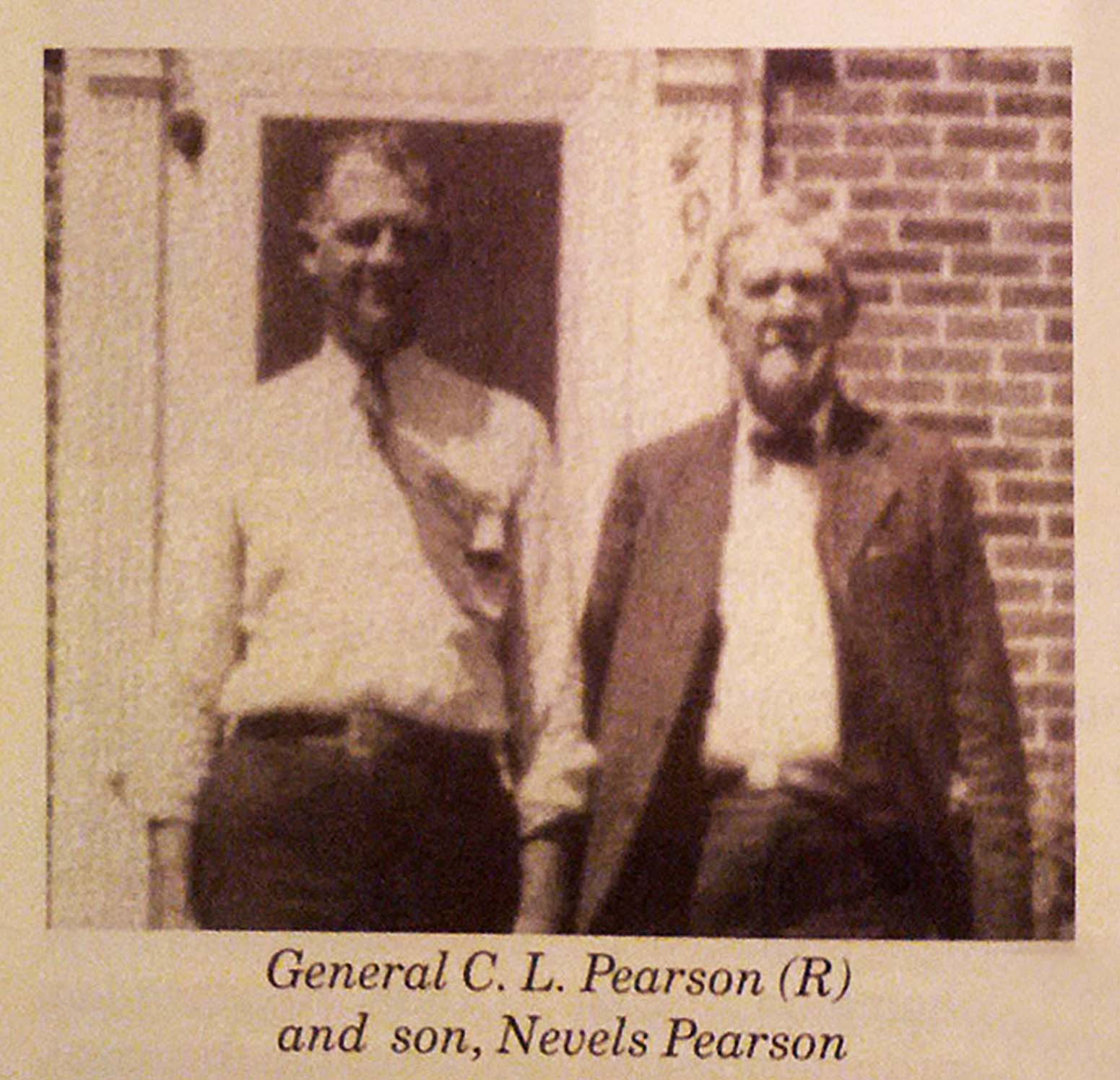
[Older brother, Nevels Pearson (upper left) also enlisted in the army.]

Vauquois Hill


The Meuse-Argonne Offensive offensive began with a barrage on the night of September 25th and an early morning assault on the 26th.


Varlourd and his company faced the enemy at Vauquois Hill. Before the war, this was a tiny hillock overlooking the town ow Vauquois. French and German units fought for control of the strategic hill, totally obliterating the town. By September of 1918, the Germans were well entrenched in the honeycombed hill.

A surviving soldier of Company C described the assault that took place on the morning of September 26th.

September 19, 1918. Proceeded by truck to Foucacourt, Meuse. September 20, 1918. Marched to woods near Auzeville.

September 25, 1918. Left at 7 pm and marched into position between Aubreville and Vauquois Hill. On our way up the whole sky to the north and northwest blazed forth with the fire of heavy guns laying down a barrage which was to start the Meuse-Argonne Offensive in just a few hours.
September 26, 1918. …Went over the top at 5:30 am. We captured Vauquois Hill early and proceeded northwest toward Cheppy, to a point just short of Charpentry.

Battle lines, Sep 26, 1918, Meuse-Argonne Offensive


Cheppy, France


September 27, 1918 - The 28th Division on our left was having tough going through the heavily wooded Argonne Forest, and this began to expose our left flank to crossfire, and this forced our main direction more and more to the west and northwest. Our men assisted the 28th Division at Varennes and Montblainville. On this day we overran Charpentry and Baulny, and came out on higher ground beyond to the north.

September 28, 1918 - We had to repel a counterattack early this day, and thereafter followed the day of our heaviest losses in casualties as we pressed toward Exermont with our left flank increasingly exposed to crossfire. Our front became almost a salient into the enemy line and we suffered grievous losses all during the day.

Citation


Varloud Pearson was killed in action near Exermont.

The President of the United States of America, authorized by Act of Congress, July 9, 1918, takes pride in presenting the Distinguished Service Cross (Posthumously) to Sergeant Varlourd Pearson (ASN: 1449077), United States Army, for extraordinary heroism in action while serving with Company I, 137th Infantry Regiment, 35th Division, A.E.F., near Baulny, France, 28 September 1918. Though wounded three times by shrapnel and machine-gun bullets, Sergeant Pearson refused to be evacuated and continued to lead the advance of ; his platoon, remaining in command for several hours till he received a fourth wound which proved fatal. General Orders: War Department, General Orders 95 (1919).


 The finish of A. E. Houseman's poem To an Athlete Dying Young

...

Eyes the shady night has shut
Cannot see the record cut,
And silence sounds no worse than cheers
After earth has stopped the ears.

Now you will not swell the rout
Of lads that wore their honours out,
Runners whom renown outran
And the name died before the man.

So set, before its echoes fade,
The fleet foot on the sill of shade,
And hold to the low lintel up
The still-defended challenge-cup.

And round that early-laurelled head
Will flock to gaze the strengthless dead,
And find unwithered on its curls
The garland briefer than a girl’s.

Friday, October 5, 2012

General Charles Lafayette Pearson

They called him general. General Charles Lafayette Pearson, Charles a name fit for a king who lost and won his crown, Lafayette, for a general who fought for a noble cause.


A graduate of law at the University of Alabama, he was too young to have fought for the south in the Civil War, too old to have fought in the Spanish American War. The French gave him his honorary title when he completed four years of graduate study in France, where when the debate continued over revolution and counter-revolution, church and state, and monarchy and republicanism. Young Charles, for he was perhaps in his late twenties by now, was influenced by the moderate President Jules Grévy and his brother Jules Philippe Louis Albert Grévy, who was one of his instructors.

He returned to Alabama and to his father’s farm. He married the beautiful and mysterious Zenia Blasingame, and they had nine children, unusually named and exceptionally well-educated, who, of those that survived the rigors of childhood, grew up, moved away, and lived good lives.

Charles became Brigadier-General of the Alabama State Troops, and so earned his title.

Charles, good son that he was, cared for his father and mother until their deaths. He practiced law in Tallapoosa County and oversaw a large farming operation in the red clay hills of Alabama that grew to over 42,000 acres.

The farm is gone, sold to a lumber company, and the land has reverted to pine trees and kudzu, the children are gone, what remains is a small cemetery lost in the woods, appropriately called the General Charles Lafayette Pearson cemetery.

The general died on January the 12, 1894 and his remains lay along with those of his father and mother and a few other souls.

Notes.

During a time in Alabama state history when ordinary working-class citizens opposed compulsory education, he insured his children got a good education. Several of them went to Emory College in Atlanta, others to Kansas State in Manhattan. One son, James Nevels Pearson taught at Michigan State after graduating from Kansas State. Another son, Varlourd left Kansas State to enlist in the Army during World War I (He died during the Meuse-Argonne Offensive and received the Distinguished Service Medal), another son Madison Bertand Pearson, also graduated from Kansas State University and played on the World Champion Chicago Bears team in 1932.

The general's oldest surviving son was Carlos Lopez Pearson. There is little information available about him other than a draft registration for World War II that declares he was born in Hudleyville, Alabama, March 14, 1887, and was then (1942)living in Wenatchee, Washington. The name Carlos Lopez is a play on his father's name, Charles Lafayette - Carlos is Spanish for Charles and Lopez comes from Antonio López de Santa Anna, the Lafayette of Mexican independence.

I am not able to independently verify that Charles Pearson was a Brigadier General of the Alabama State Troops or to learn the exact organization referenced.

Personal note.
 
The General is my great great uncle.

Great great grand-daddy James Madison Pearson (1817 - 1891) was born in Monticello, Jasper County Georgia. In the 1830's, he left Georgia for the new state of Alabama, settling on land recently taken from the Creek Indians along the Coosa River,  some 12 miles north of Dadeville, in Tallapoosa County.

Read about the Creek Wars, Alabama Department of Archives.

James and wife Elizabeth Ann Brown had nine children. See O'Farrell Family. Included in this brood, was my great great grandfather Benjamin Rush Pearson, born 1849, and his younger brother Charles Lafayette Pearson, born 1854.


More sources and notes


General Charles Lafayette Pearson, courtesy of George Campbell


Two story family farm in Alabama in the Auburn University Libraries

 Find a Grave


Tuesday, October 2, 2012

Pearson's Dragoons

Note. I have no information to directly connect Pearson's Dragoons with my family. I just wanted to get this down in case some information should turn up.

The Civil War impacted every corner of the South and Tallapoosa County was no exception. One estimate is that small rural Tallapoosa County contributed almost 3,000 soldiers to the war effort on the Confederate side, and of these almost a third perished. A Few Soldiers of Old Tallapoosa.


Campaign Flag First Alabama Cavalry Regiment


Pearson's Dragoons 

The First Alabama Cavalry Regiment was organized at Montgomery, November, 1861 under the command of Colonel James H. Clanton.

The First Alabama Cavalry Regiment fought at the battles of Shiloh and Murfreesboro. It was also part of the rear guard which protected the retreat from Tullahoma and Chattanooga, losing severely at Duck river; fought at Chickamauga, Clinton and Knoxville, and took a brilliant part in the Sequatchee raid. It was engaged in retarding Sherman's advance on Atlanta.

Read more.

Company D of the First Alabama was also known as Pearson's Dragoons. It is also called Company C and may have had other designations due to reorganizations. It was formed in Tallapoosa County. Its regimental commanders included: John G. Stokes (resigned, 25 Oct 62); Jesse W. Fitzpatrick (resigned, 26 Nov 64); Henry C. Washburn (1st Lt., paroled as Capt., Co. "D").

The company designation changed during the war due to reorganizations. Other designations include: "Co. C, 1st Alabama Cavalry; Co. D, 12th Alabama Cavalry, later 2nd Co. C". I have also seen reference to Companies C, D, and F. See following.

The 1st Alabama Cavalry Regiment surrendered at Charlotte, North Carolina, May 3, 1865. Pearson's Dragoons was then under the command of Henry C. Washburn, and designated as Company D. Seventy-two officers and men of the Alabama First Cavalry signed paroles. Re: James Henry Pitts.

Lost in all of this is the explanation for the name Pearson's Dragoons. The Pearson family lived in Tallapoosa County from shortly after the War of 1812 and the Battle with the Creeks. They owned a significant amount of land in the county. That land was located off modern Highway 280 and up Slaughter’s Crossing Road. Today, the land is owned by Kimberly Clark.

The land was passed down to General Charles Lafayette Pearson, but he was born in 1854, and would have been only six or seven at the outbreak of the Civil War. His father James Madison Pearson, born Monticello, Jasper Co., Georgia in 1817 is the more likely connection, if any, to the company name. He was an attorney and farmer, who passed the farm down to his son Charles. Family cemetery of Charles Lafayette Pearson, including his father James Madison Pearson.

There were nine children born to James Madison Pearson and his wife Mary White. My connection is to older son, Benjamin Rush Pearson, my great-grandfather, who became a doctor and practiced in Birmingham. His son, my grandfather, was also named James Madison Pearson.

My grandfather often spoke about his adventures in and around Dadeville and Tallopoosa County.